
Vanessa Kroll Bennett, S93: Supporting Adolescents
During a visit to the Mountain School, alum and puberty educator Vanessa Kroll Bennett discusses how community, empathy, and supportive adults—shaped by her TMS experience—can transform the way we understand and support adolescents.

Vanessa Kroll Bennett S93 returned to campus to lead a professional development workshop after TMS faculty finished reading her recent book, This Is So Awkward: Modern Puberty Explained. Vanessa is a national bestselling author, co-host of the This Is So Awkward podcast, President of Content at Less Awkward, and a frequent contributor to Scary Mommy. She has appeared on Good Morning America, CBS Mornings, The Drew Barrymore Show, and Morning Joe, and has been featured in outlets including The New York Times, Oprah Daily, and PEOPLE. Read to learn more about Vanessa and hear how her time as a TMS student influenced the work she does today.
Profile by Jo Almond S24
“You never know where the Mountain School is going to reemerge in beautiful and wonderful ways in your life.”
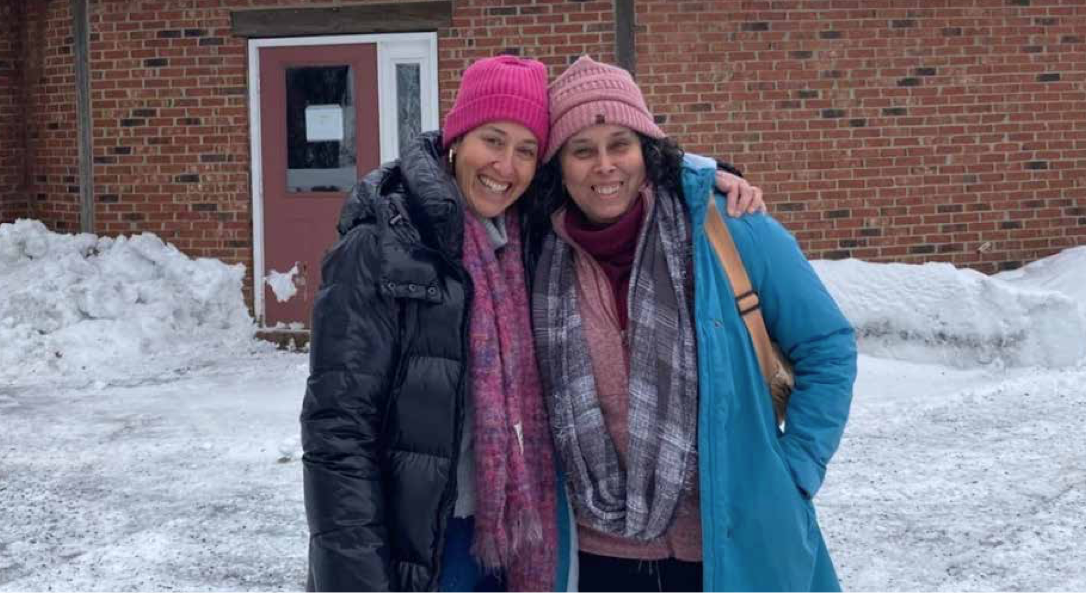
Vanessa and Katrina Monzón S93 catch up on a snowy January day.
Vanessa Kroll Bennett knows how to laugh: her laughter was one of the hallmarks of our S93 semester, booming across the Dining Hall after a sideways game of Spades or floating over Garden Hill. Ahead of this spring semester, TMS faculty read Vanessa Kroll Bennet’s recent book, This Is So Awkward: Modern Puberty Explained, and invited her to lead a professional development workshop. Co-written with Cara Natterson, MD (with whom Vanessa co-hosts a podcast of the same name), This is so Awkward provides insights into both the science behind the changes adolescents experience during puberty as well as practical advice for the adults supporting them.
In a community like the Mountain School, where students and adults learn, live, work, and play together, there are often unique challenges—and tremendous opportunities— in supporting young people during this time of their lives. Having attended the Mountain School herself, Vanessa was able to draw on her experiences as a student here, including the relationships she built with the community of adult faculty. Alongside handling mood swings, supporting good decision making, and offering empathy while also setting boundaries, Vanessa reminded us that adults need to leave their own adolescent baggage at the door if they want to be fully present and available to young people seeking guidance.
Over the past thirty years, Vanessa and I have shared a college campus, mutual friends, and some memorable adventures with semester-mates. But, being back on the Mountain School campus and laughing together reminded me of one of my favorite quotes from Madeleine L’Engle, “I am still every age that I have ever been.” We were all teenagers once, some of us were lucky enough to be teenagers together here.
I interviewed Vanessa Bennett over Zoom in late April. During our hour-long call, I was immediately struck by her earnest and frank manner, as well as the confidence and passion she radiated—traits I have learned are hallmarks of TMS alumni. Vanessa and I spoke about a myriad of topics: puberty and sex-ed, memory, support systems, nostalgia, writing, even dish crew! (She’s a proud Dirty Hands Pots and Pans.)
Though on its face the Mountain School might not seem to have much to do with puberty education, Vanessa and I discussed how learning to live in community has the potential to impact your relationships for the rest of your life.
Vanessa Kroll Bennett began her career by launching a company called Dynamo Girl. The goal of Dynamo Girl is to “create a foundation for [girls]” beginning around kindergarten, using sports classes and social emotional learning to create what Bennett describes as a “bastion of strength” to carry them into puberty. “Girl’s self-esteem peaks at nine,” Bennett told me. “And then precipitously declines throughout the teen and tween years.” Hearing this, I began to think of the downstream and upstream solutions lesson we had in Environmental Studies: the goal of Dynamo Girl is not to band-aid the gaping wound of teenage self-esteem—it is to prevent self-esteem from dropping in the first place.
“I think tweens and teens are the coolest, funniest, smartest, most insightful, most brutally honest, most thoughtful, most loving human beings on the planet,” Bennett confessed to me. “They get the worst rap, and I think the world needs to completely reframe how they think about kids this age.”
Much of Bennett’s current work centers around parents and transforming kid’s support systems. “If you can get to people in these formative years, and you can get to the adults who
are caring for them, and help shift the way the adults support them, speak to them—what information the adults share with them, the way they are in dialogue with each other—then you can actually change the entire narrative,” Vanessa told me. “All of the downstream living could look better, healthier, safer, more supportive.”
With all the incredible work she’s doing in the world, I had to ask how much being at the Mountain School had influenced it. “Living amongst 45 very different teenagers taught me how vast the experience of being an adolescent can be,” Vanessa explained. She said the main skill the Mountain School taught her was empathy and the importance of supportive adults in adolescent’s lives. “Having adults who really see you—who want to motivate you—I found a real appreciation for that at TMS when I was away from my own family.”
Communication home was a lot trickier when Vanessa attended TMS than it is now. As a Spring ‘24 student, there’s hardly been a day where I haven’t texted my Mom or Dad from my laptop, but Vanessa said that though there was a landline in the dorm, she had “no memory of speaking to [my parents]. I was really really away from them, but I felt so loved and supported by the adults surrounding me at the Mountain School.”
The connection to Vanessa’s work in parent education and even more systemic advocacy seemed clear: in order to fully support teens and tweens, we need to not only support parents and kids, but society as a whole. We need to give teachers, librarians—anyone who works with kids—the tools to support adolescents fully. And this is especially important for kids who have been separated from their normal support system or kids who never had them in the first place.
When I asked Vanessa about her memories of the Mountain School that most stick out, she mentioned several everyday scenes: playing softball after the Spring thaw, mucking out the barns, playing on Garden Hill (right next to her dorm, Underwood!). But the most resonant memory, she told me, was a science hike she took after a huge snowstorm. They were on snowshoes and exhausted by the time they reached the base of the last rise. Vanessa’s EnviSci teacher gave them a choice: if anyone was too tired, they could rest at the base of the rise; anyone who felt up to it could hike up to the top, for a spectacular view. “In my head, I was like, ‘Do I push myself a little bit more, or do I stay?’” Vanessa finally decided to go.
“So we get to the top, and the view is spectacular,” she remembered. “And I’m so proud of myself, that I had pushed myself that little extra, that I had made myself uncomfortable in a way.” Vanessa said she thinks back to that moment often. “There are times in life where it’s good enough, and you can stay right where you are, but I do think there are times when there’s real opportunity to take that one step further, and I definitely learned that.”
I also asked Vanessa about sex-ed at the Mountain School. Does she, as a sex- ed expert, think the program is a good opportunity to affect kids from lots of different homes and schools? Could we be doing more?
Vanessa told me there had been lots of improvement in sex-ed support systems at TMS since she was a student. (For example, TMS now has a nurse and a social worker.) But the impact of TMS on healthy relationships, Vanessa believes, is much greater: “Every semester, you are building and dismantling a community in the span of four or five months. What creates healthy relationships and healthy sexuality are the same things that go into building community.” One thing Vanessa encourages the Mountain School to do is more explicitly draw a line from one to the other.
Lastly, I asked Vanessa what advice she’d give our semester for our final weeks and return home. “Relationships and connections get forged in the final days and weeks of an experience,” she said. “Leave yourself open to connecting with new people.” And after the semester’s time finally ends, : “Be honest with the people in your life who love you; it’s hard to be not at the Mountain School. And also think about what from TMS you can bring with you back to your life at home.” Vanessa emphasized how much TMS changes your life forever, not just for one semester.
“You never know where the Mountain School is going to reemerge in beautiful and wonderful ways in your life,” she said. “It's like a surprise gift that pops up when you least expect it.”