
374 Voices (Part One): An Overview of What We Heard
by Chris Lauricella, Director of Development
The first in a series sharing results from The Mountain School’s 2026 Listening Survey.
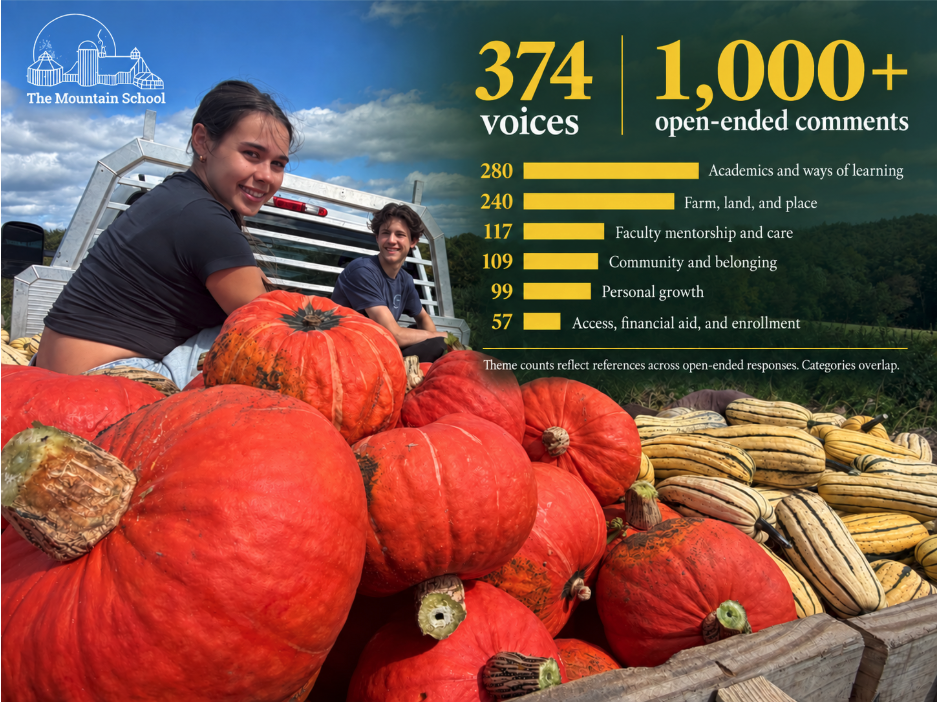
This summer, The Mountain School invited alumni, families, faculty, staff, and friends to reflect on their experiences with the School and their hopes for its future.
374 people responded, contributing more than 1,000 open-ended comments about what makes The Mountain School meaningful, what should never change, and where the School should focus as it looks ahead.
The results offer a rich picture of a community that believes deeply in The Mountain School. They also offer practical guidance on the experience respondents want to preserve, the priorities they believe deserve attention, and how they would like to contribute to the School’s future.
By the numbers
Our analysis identified several recurring themes across the open-ended responses:
280 references to challenging academics and different ways of learning
240 references to the farm, the land, and a sense of place
117 references to faculty mentorship and care
109 references to community, belonging, and relationships
99 references to personal growth and transformation
57 references to access, financial aid, and enrollment
These categories overlap. A single response might describe an academic experience, a faculty relationship, farm work, and personal growth. The counts therefore reflect how often themes appeared, not the percentage of respondents who expressed a particular view.
That overlap is itself instructive. Respondents rarely described one isolated feature as the source of The Mountain School’s impact. Instead, they wrote about an integrated experience in which learning, place, work, relationships, and responsibility reinforce one another.
Four findings to guide us
The survey points toward four broad conclusions that we will examine more closely in the coming weeks:
The essential experience remains powerful
The two most frequently identified themes were academics and different ways of learning, with 280 references, and the farm, land, and sense of place, with 240 references.
Respondents described an education that joins intellectual challenge with direct experience. The next post will consider how those elements work together, what respondents believe must always endure, and what the survey’s recommendation results reveal about the community’s confidence in the School.
Relationships give the experience lasting meaning
Respondents made 117 references to faculty mentorship and care and 109 references to community, belonging, and relationships.
They frequently connected those relationships to growth that continued beyond the semester. Personal transformation, including confidence, independence, resilience, and a greater sense of responsibility, appeared 99 times in our primary-theme analysis.
A later post will explore the people who make the place and the relationships that continue to shape alumni long after they leave Vershire.
Access is both a mission priority and a practical concern
Access, financial aid, and enrollment appeared 57 times across the open-ended responses.
Respondents expressed a desire to make The Mountain School available to more qualified students, regardless of their families’ financial circumstances. They also recognized that affordability and enrollment are connected to the School’s ability to build strong, diverse cohorts.
We will devote a post to the relationship among access, mission, and The Mountain School’s long-term strength.
The TMS community wants to participate
Respondents did more than reflect on their experiences. Many offered practical ways to help, including connecting with prospective families, representing the School at sending schools, hosting regional gatherings, sharing professional expertise, strengthening alumni relationships, and supporting the programs they value.
From listening to action
Some survey findings affirm what The Mountain School is doing well. Others raise questions that require further study or concerns most useful for internal planning. Still others point toward stories the School should tell more clearly and opportunities for the community to become involved.
This series will not attempt to reproduce every answer or resolve every question raised in the survey. It will share the strongest recurring findings, explain why they matter, and describe how they can help guide The Mountain School’s work.
Thank you to everyone who trusted us with their reflections.
The results offer both encouragement and responsibility: encouragement that the essential Mountain School experience continues to matter deeply, and responsibility to preserve, strengthen, and extend that experience for the students who will come next.
In the next post, we will look more closely at how strongly respondents believe in The Mountain School, and share one particularly powerful measure of their confidence in the experience.
About the survey
The Listening Survey combined quantifiable questions with qualitative opportunities for respondents to describe their experiences, concerns, and aspirations in their own words.
Responses were voluntary and came predominantly from alumni, so they do not represent a scientific measure of every constituency. They offer something different and deeply valuable: substantial, thoughtful reflections from people who know The Mountain School and care deeply about its future.
This distinction matters. The results should not be read as a vote or a definitive statement from every community member. They provide substantial evidence that can help us identify recurring experiences, ask better questions, and guide planning and communication.
