
by Zac Hewitt, Assistant Director & College Counselor
I promise this post isn’t going to be a downer.
Only the first half.
November 1st, 2026 marked my fourteenth year thinking about the ever-stressful Early Decision College Application Deadline and how its entwining with the high school experience births all manner of stressors: externally-driven definitions of success, self-imposed expectations of achievement, and “the return on investment” question. Pride. Competition. Anxiety. The Imagined Self.
According to research conducted by NACAC in 2023, high school students found the college application process to be incredibly stressful, high-stakes, and intrinsically unfair:
52% said this has been more stressful than anything else they have done academically
65% reported feeling as though they were “just a number” during the process
72% believed the process clearly advantaged the wealthy and privileged
73% feared a small mistake in their application could limit their chances of acceptance
74% believed there was a lot of bias involved in college admission office decisions
76% of students said completing their applications felt like a decisive moment in their lives
2026 also marks 10 years since the Making Caring Common Project at Harvard Graduate School of Education (HGSE) released its first Turning The Tide report, a sharp call for greater compassion and consideration of the common good in the admissions process - a call led by one of the most selective universities on Earth.
In the years between the initial release of the report and what is now my fifth semester at The Mountain School, I worked in college counseling offices at a range of independent day and boarding schools across the United States - from Los Angeles, California to Exeter, New Hampshire - and have felt the landscape of college admissions shift drastically under the nation’s collective feet:

In 2019, Operation Varsity Blues made headlines around the US and caused many to pause and ask, “is this what it means to pursue an ‘elite’ college education - bribery, fraud, cheating, false athletic records?”
Varsity Blues was followed almost immediately by the COVID-19 pandemic, shuttering some campuses and - from an admissions perspective - putting the already growing trend towards test-optional admissions into overdrive. While, for many, the move away from standardized testing was a necessary and important move towards equity - it also caused application numbers to spike and admit rates to drop, adding fuel to the scarcity mindset that drove the individuals behind Operation Varsity Blues to begin with.
From 2020-2025, we saw a cascade of shifts at the federal level - changes to financial aid, changes to Title IX, investigations into discrimination on university campuses - and the SFFA vs Harvard case in which the Supreme Court ruled affirmative action in college admissions to be illegal (except at military academies, though that prohibition would follow via Executive Order in 2025).
Now we see attempts to shutter the Department of Education at the same time as both students and schools wrestle with the omnipresence of artificial intelligence - used not only to take notes and complete essays, but to algorithmically sort applicants at all manner of universities. (When I started my career, I never heard a student talk about a university’s attempts at “yield protection,” but by the time I left, it was a regular conversation).
Through all of this, the question of the cost of college, employment and economic futures, the “demographic cliff” (the long predicted downturn in the number of 18 year olds, correlated with the Great Recession in 2007-2008) has made everyone: admissions officers, school counselors, parents, and especially students, feel as though the pathways to higher education are windier, narrower, and - at some institutions - more crowded.
Now you’re asking:
“What does any of this have to do with TMS?”
“Why are you subjecting us to one more doom-and-gloom thinkpiece?”
“I’m here for the llama, come on!”
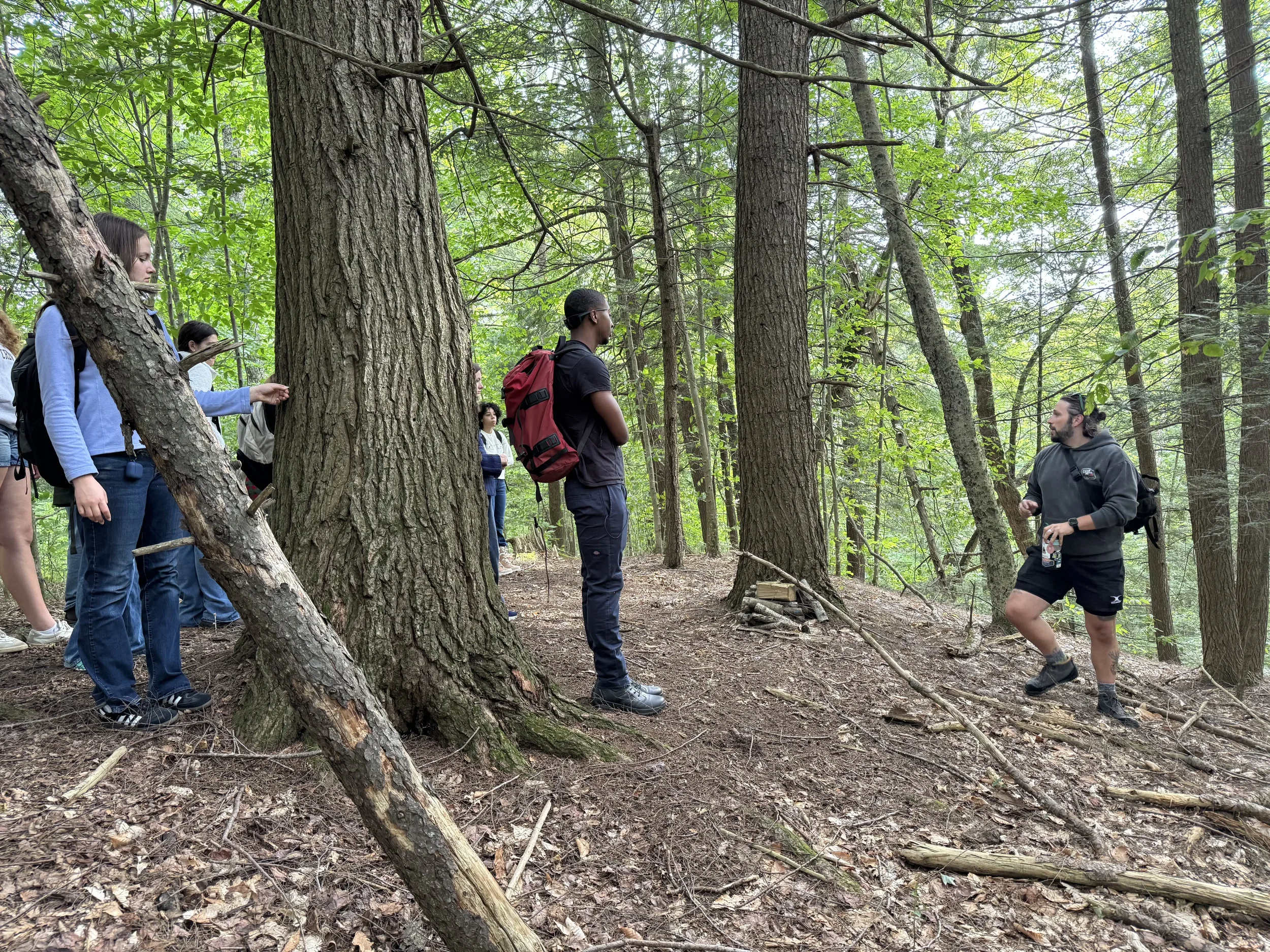
In short, because I believe that TMS - with our experiential, place-based education, our intentionally small community, our sometimes countercultural approach to relating to humanity and the natural world, and our belief in the ability to change detrimental systems - is an antidote to all of this. And “all of this” is much bigger than college stress. For those faculty and alumni I’ve spoken with in my time here, you’ve probably heard me call TMS “the school for hopeful solutions” - and I remain sincere when I say it.
Returning to Turning the Tide for a moment: when the 2026 report was released, it spurred a great deal of conversation in the niche corners of the internet where us NACAC members congregate. One commenter cited a study (attributed to Gallup and HGSE, separately) reporting
“51% of young adults ages 19 to 25 reported lacking meaning, purpose, or both. Among those young people, 65% also reported anxiety or depression. And when researchers looked at students facing intense achievement pressure, the ones who had a sense of purpose were significantly more able to weather the pressure. Students without a sense of purpose were much worse off.”
Not only are these numbers frightening and deeply sad, it’s also clear that this issue goes so far beyond the narrow lens of college admissions (though we cannot gloss over the role of “achievement pressure” in American education and should listen closely when asked “why am I learning this, what’s the point?”).
It seems as though most people have read Jonathan Haidt’s The Anxious Generation at this point, and more and more people are coming to understand climate anxiety and climate grief, reading the works of Britt Wray or Spencer R. Scott. The news, and the bleakness of each headline, permeate every piece of media we consume. (Do we need to call it the “Doomsday Glacier”?) So, we’re not talking just about academic achievement and anxiety, but the big picture of “The Future” from an adolescent perspective. “Why should I care about calculus, when the country is running out of water?”
If the only messages provided are those of scarcity, war, collapse, and tragedy - how can youth build and maintain purpose in the face of such an onslaught?
To me, the key to much of this lies in two ideas. Two ideas that The Mountain School does better than any school I’ve seen: connection and hope.
Real connection to one another and to the land around us - unmediated by a screen, a comment section, a panopticon of captured social experience - reminds us that life is not, in fact, a zero-sum game. This human relationship is not defined by “you got something, therefore I did not.” Collaboration, mutual support, and repair are the hallmarks of successful societies since humanity first settled into an agricultural lifestyle. Rampant individualism may lead to your own short-term success, but at what cost? And then what?
At TMS, each day is an exercise in this type of connection - whether it’s the shared work of dish crew, the land-connectedness of environmental science, the care and medical knowledge of a wilderness first aid course, or knowing that the pigs are relying on you for food - all of it is connected. Through that connection, through that interdependence - as our mission says - comes a sense of purpose. Our work is visible to one another. Each person in this community matters in tangible and intangible ways. The land we rely on relies on us in turn. There is purpose in caring for a place and with each class taken, each trip off campus, we ask students to expand their understanding of place and how we care for it. The field of positive youth development calls it “contribution,” and it is essential in order to thrive.

These small caretakings may not be grand actions, but as Tolkien wrote, “yet such is oft the course of deeds that move the wheels of the world: small hands do them because they must, while the eyes of the great are elsewhere.”
We must do these things here, together.
Which leads me to the second idea: hope. Famously, the thing with feathers, the thing left in the bottom of that Grecian box. Countless thinkers and writers have shared thoughts on the relationship between hope and action, though my favorite I’ve ever heard is “hope comes from taking hopeful action” (or the Björk lyric “hope is a muscle”). Acting from the belief that you can have an impact on something, someone, some system - reinforces that belief. We cannot sit and let the world wash over us - there is work to be done, small adjustments to be made, moments to be preserved. The Self cannot be consumed by the (poly)crisis.
The key is to not let yourself be overwhelmed - in Food Systems, students are not asked to completely redesign the American food system - but to think about ways in which they can affect change. Is it possible to buy from your local farmers market? Is it possible to use your financial resources to support policy changes? Can you identify needs that can be addressed at the local level? Can you build bridges and understanding between different people? From these small actions, what can you continue to build?
I like to think TMS is taking the solarpunk approach - not just trying to avert dystopia, but to fall in love with the ecological alternative.

So, how did we get from college stress to ecological futures? At the most basic level, it’s because I have seen how a single semester at TMS can transform a student’s outlook.
Before I came to Vershire, I’d been sending students to The Mountain School for years - many of them chose to step off their planned path because they were burned out or fed up with competitive school cultures or wanted to remember that there was life and learning outside of a classroom discussion or to get their hands dirty and try something new - and every one of those students came back energized and joyful. They were less focused on the “T20s” of the ApplyingToCollege subreddit, and were able to see themselves in myriad places, having found a sense of connection to something greater than themselves. They’d all found a sense of purpose that had previously been clouded or lacking - some as simple as a drive to learn or connect in new and different ways, some as grand as economic and technological theories to rewrite our relationship to Nature.
They were happy, and they were hopeful. I think that’s ultimately why I too quit my full-time college counseling career to come to TMS: there was more to life than a list of 8-12 schools.
November 1st will come every year, as will “Ivy Release Day,” as will “Decision Day.” Students will graduate from The Mountain School, will graduate from high school, have incredible experiences in higher education, and lead lives of purpose. Or they may adjust, midlife, and renew the thing - somewhere inside them - that has always given them hope and was just in need of a little action. So, while TMS continues to offer a rigorous academic program and plenty of college support, the real magic of this experience isn’t in what institutions TMS alumni choose to attend next, but in horizons much farther out and much deeper in.

